
Matimo™
AI agents that reason,
ask permission, and answer for what they did.
Governance isn't bolted on. It's how Matimo is built.
Any team builds them, no code required. Sixteen reasoning strategies adapt to the job instead of a fixed script. Every consequential action still needs a human's sign-off, logged to one audit trail.
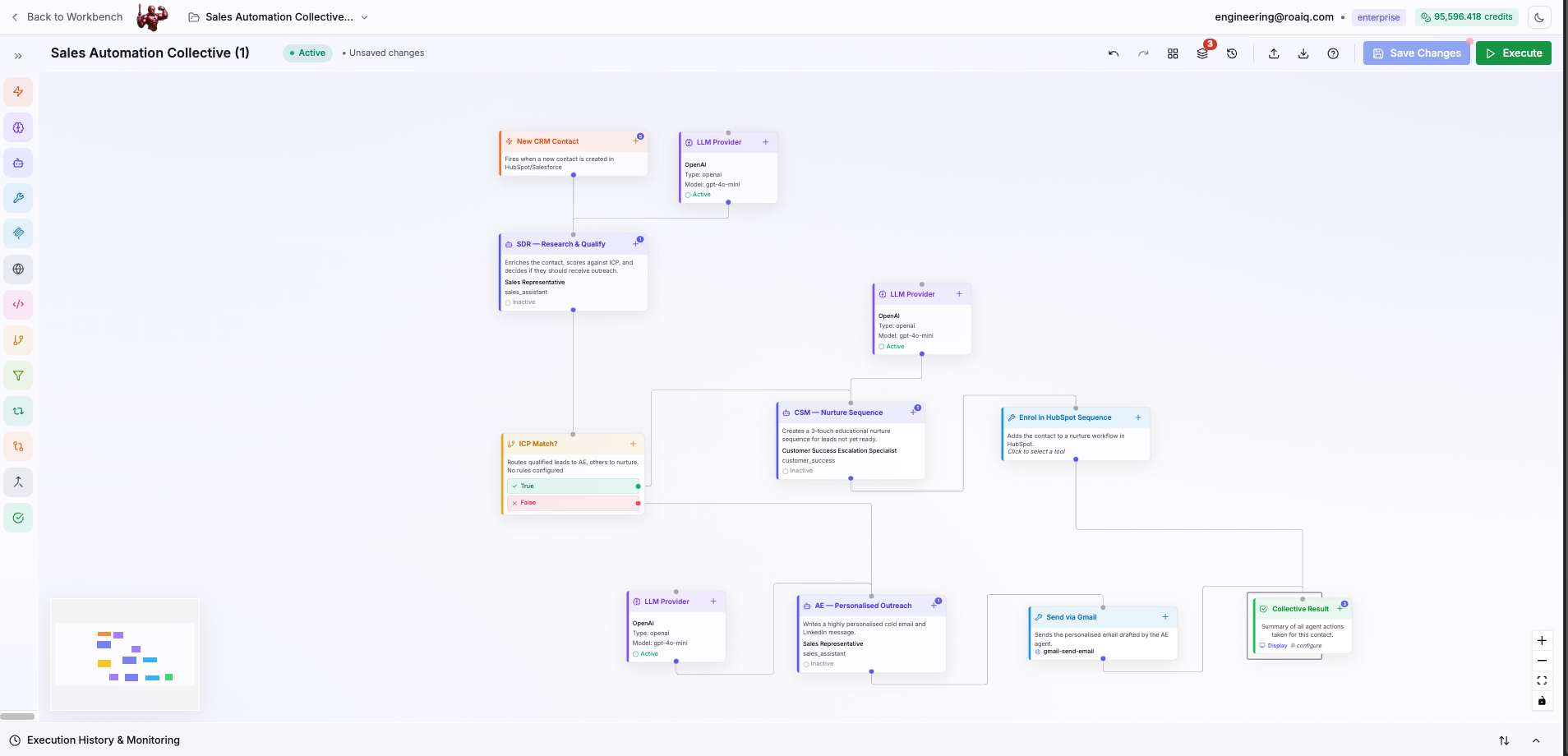
This is what building an agent workflow actually looks like
A real Matimo Studio workflow: a CRM trigger routes into an SDR agent, a branching qualification rule splits the lead, a nurture path or a personalised outreach agent picks it up, and a Gmail send closes the loop, every step wired to a reasoning engine and a real tool.
Governance is becoming the law, not just best practice
The EU AI Act's human-oversight requirements for high-risk systems are already in force. In the US, a wave of state-level bills, including California's SB-833, are pushing the same principle toward a hard requirement: a human has to be able to intervene in what an agent does. Most easy-to-use agent platforms weren't built with that requirement in mind from day one. Matimo was.
Easy to build, or safe to trust? We don't think you should have to choose.
We compared the market on two dimensions: how much effort it takes to get an agent running, and what actually happens when that agent takes a real action. Most platforms are strong on one and still finding their footing on the other. Treat this as a starting checklist for your own evaluation, not a verdict.
built into a CRM or productivity suite
connector-based automation platforms
fast on-ramp AI agent startups
open-source agent orchestration libraries
governed tool-execution and MCP gateways
Matimo
Agent Operations Platform
No other row above covers both dimensions with one product. Pair a builder from one category with a governance vendor from another, and that's a second contract, a second integration, and a second team to maintain. Matimo was built to be the one row that covers both.
Everything You Need to Build and Trust AI Agents
Four pillars, each backed by a real, inspectable capability, not aspiration.
Human-in-the-loop approval is wired into the live execution path, not a settings toggle, and every tenant runs on real, enforced row-level data isolation, never a shared workspace with a label.
16 distinct reasoning strategies (ReAct, Chain-of-Thought, Tree-of-Thoughts, Reflexion, Plan & Execute, multi-agent, and more) so an agent adapts to a case your flowchart never anticipated.
An agent can propose a new tool for itself at runtime; nothing runs until a human approves it. The platform grows its own capability instead of waiting on a vendor roadmap. Rolling out now with design partners as we head toward general availability.
Bring your own key across OpenAI, Anthropic, Google, xAI, or local models. The tool layer underneath is open-source, so you are never locked into one vendor’s ecosystem.
+11 more strategies
What picking a reasoning strategy looks like inside Matimo
One vendor. One runtime. One audit trail.
Matimo isn't a single product. It's a stack, and every layer feeds the same governance model, so there's no stitching together a builder from one vendor and a policy engine from another. Matimo Governance is the layer the other three answer to: nothing ships without it knowing.
Matimo OSS
Open, free, on GitHub
The open-source tool, skill, and policy engine. Connects an agent to Slack, a database, an email inbox, anything with a tool definition.
Matimo Studio
The visual canvas
A drag-and-drop builder for non-technical teams to design and chain agents and workflows without writing code.
Matimo Workbench
The command centre
Where agents actually go to work: reasoning engines, deployment across form factors, multi-tenant lifecycle, billing.
Matimo Governance
Policy & audit layer
Risk-classified tool policies, human-in-the-loop approval, and an audit trail that shows what happened and why, at any moment.
wants to send an email via Gmail on behalf of a customer.
What a held tool call looks like inside Matimo, before it ever runs
Agents access tools for Slack, Gmail, GitHub, HubSpot, Notion, Twilio, Postgres, and more, sourced from Matimo's community registry. Admins can enable or disable tools per tenant from the dashboard.
Tool calls flagged as higher-risk are held for human review before execution. An admin can approve or deny each request directly from the Tools › Approvals panel.
Each workspace maintains its own set of enabled tools and credentials. No tool configuration or data leaks across tenants.
Matimo OSS A Roaiq™ product: the open engine powering tool integrations across Matimo
Four products, one governed runtime. Pick where you start.
Not every team starts in the same place in the stack. Here's why each layer exists, when you'd actually reach for it, and who it's built for.
Matimo OSS
Open, free, on GitHub
- Why it exists
- Tool execution shouldn't be a black box, or a rebuild-it-yourself project for every new integration. OSS is the open engine that connects an agent to Slack, a database, an email inbox, or any tool, with risk classification built in from the start.
- When you'd use it
- When you're building or extending agents yourself, on your own framework or infrastructure, and want a governed tool layer instead of hand-rolling auth and approval logic for every integration.
- Who it's for
- Developers and platform engineers, and anyone evaluating Matimo before ever paying for anything.
Matimo Studio
The visual canvas
- Why it exists
- Designing how an agent, or several agents, actually work together needs to be visible and debuggable, not a wall of code. Studio is the drag-and-drop canvas for that.
- When you'd use it
- When you're assembling the actual workflow: which agent hands off to which tool, how a branch splits, what data moves where. The moment you're building, not just configuring.
- Who it's for
- The person actually putting the workflow together, often non-technical: an ops, RevOps, or CS lead, not necessarily an engineer.
Matimo Workbench
The command centre
- Why it exists
- Most teams don't want to build reasoning, multi-tenancy, billing, and deployment infrastructure just to run an agent. Workbench is the hosted platform where all of that comes assembled.
- When you'd use it
- When you're ready to actually run agents in production, not just prototype: real reasoning strategies, real tenant isolation, and a form factor to put in front of users or your own team.
- Who it's for
- Ops, RevOps, and "Head of AI" teams at growing companies, and platform owners standardizing how their org builds agents.
Matimo Governance
Policy & audit layer
- Why it exists
- "Trust me" is not an audit trail. Governance is the policy engine that classifies risk, holds high-risk actions for human approval, and records what happened and why.
- When you'd use it
- The moment an agent starts touching anything consequential, customer data, money, or external systems, or the moment compliance, security, or IT asks what exactly it's allowed to do.
- Who it's for
- Compliance, security, and IT leaders, and any admin who needs the approvals panel and audit trail, not an enterprise-only concern.
Everything in Matimo, by product
Pick a layer of the stack to see exactly what's available today, what's rolling out, and what's still ahead.
Open, free, on GitHub
| Feature | What it does | Status |
|---|---|---|
| Policy-governed tool execution | Every tool call is risk-classified (low/medium/high/critical) and checked against your rules before it ever runs. | Available now |
| Human-in-the-loop approvals | Critical actions pause for a person to sign off, with a signed approval record and a configurable timeout. | Available now |
| Self-extending tools | Agents can draft a new tool definition at runtime; nothing goes live until a human approves it. | Available now |
| 490+ tools across 12 providers | Slack, GitHub, Gmail, HubSpot, Notion, Postgres, Twilio, Microsoft Graph, and more, ready out of the box. | Available now |
| Runs on any framework | One tool definition works unmodified across TypeScript, Python, LangChain, CrewAI, and MCP. | Available now |
| MCP server built in | Expose your whole tool catalog to Claude Desktop, Cursor, Windsurf, or any MCP-compatible client. | Available now |
| Skills system | Semantic search over your team's own domain knowledge, so agents pull in the right context automatically. | Available now |
| Bring your own secrets backend | Environment variables, HashiCorp Vault, or AWS Secrets Manager, your choice. | Available now |
Every Matimo Workbench account includes Matimo OSS's tool layer automatically. Studio is an alternate, visual way to build the same agents. Governance is opt-in, on top of both.
Common Questions
Straight answers, including about the gaps, not just the wins.
What is an Agent Operations Platform (AOP)? +
An Agent Operations Platform (AOP) is an enterprise AI agent governance platform and command centre: not a workflow tool, not a raw framework, and not a walled‑garden copilot. It's the governed runtime where any team, technical or not, puts agents to work and can show, at any moment, which agents exist, what tools they can call, and which actions require human approval.
How is Matimo different from Zapier, Make, or n8n? +
Those platforms are excellent at connector-based workflow automation: if this happens, do that. Matimo agents reason instead, choosing from 16 strategies to handle a case your flowchart didn't anticipate, with human approval on anything consequential. Teams typically outgrow a workflow tool exactly when they need a judgment call, not just a data hop.
Does Matimo support human-in-the-loop approval? +
Yes. Higher-risk tool calls are held for human review before they execute, a real gate in the execution path, not a UI setting. Admins approve or deny each request from the Tools › Approvals panel.
Can I bring my own LLM provider or API key? +
Yes, across OpenAI, Anthropic, Google, xAI, or local models, on every plan. Matimo never marks up your model costs; credits only cover its own compute and orchestration.
Is Matimo open-source? +
Matimo OSS, the tool, skill, and policy engine underneath, is open-source on GitHub. Matimo Workbench is the hosted platform built on top: reasoning engines, the visual Studio canvas, multi-tenant deployment, and governance.
What does Matimo cost? +
Free to start, no card required, then credit-based as you grow. See current plans below. Because you bring your own LLM key, Workbench never marks up the underlying model cost.
Simple, Credit-Based Pricing
Start free. Pay as you grow. Bring your own LLM key, Matimo Workbench never marks up AI costs.
Explore Matimo Workbench with no commitment
- 3 agents
- 100 credits / month
- 3 active workflows · 7 nodes each
- ReAct reasoning only
- 1 team member
- Chat form factor
- Studio visual builder
- 0 MCP servers
- Community support
For teams building real AI workflows
- 20 agents
- 1,500 credits / month
- 25 active workflows · 30 nodes each
- All 16 reasoning engines
- 5 team members
- All form factors (chat, embed, workflow, API, and more coming soon)
- Studio visual builder
- Human-in-the-Loop (HITL) approvals
- 10 MCP servers
- Credit packs available ($10 → 1 000 credits)
- Priority support
For organisations that need scale, compliance, and control
- Unlimited agents, workflows, nodes
- Unlimited credits (invoiced)
- All 16 reasoning engines
- Unlimited team members
- All form factors
- HITL approvals
- Unlimited MCP servers
- Compliance evidence reporting (HIPAA · SOC2 · GDPR controls)
- SSO / SAML (roadmap)
- Custom SLA
- Dedicated support
LLM costs: $0 from Matimo Workbench. You connect your own OpenAI / Anthropic key. No markup, ever. Credits cover Matimo Workbench's compute and orchestration only.
Ready to Build Your AI Workforce?
Start free today, or if governance has been the sticking point on your evaluation, request design-partner access and we'll walk you through the whole stack.